The sites The square that ran the city
The State Agora: Where Ephesus Was Governed
Everyone photographs the library and the theater. The square where Ephesus was actually run is the first thing you cross after the Upper Gate, and most people walk straight through it. Here is what they are walking past.
The short answer
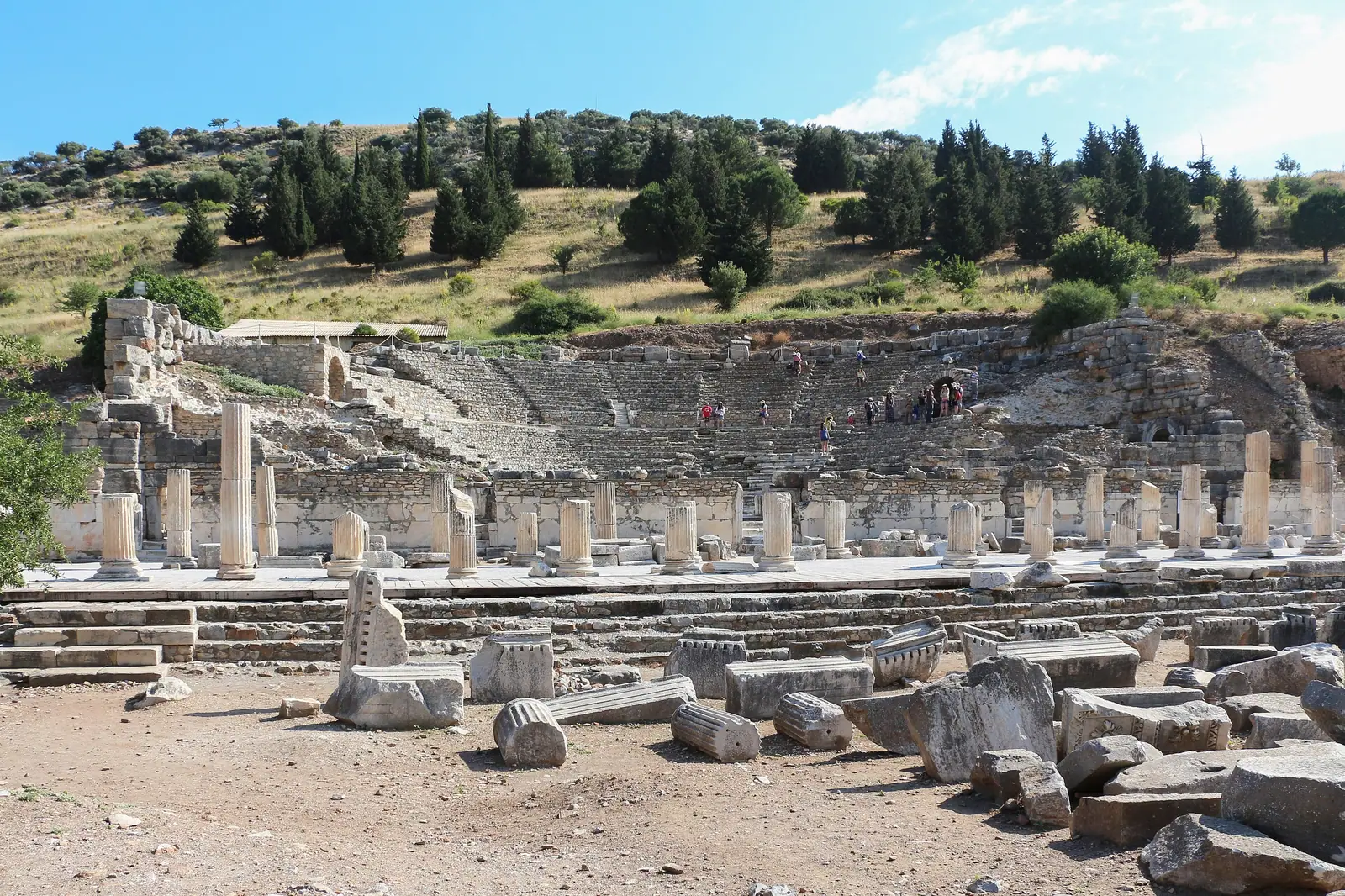
The State Agora was the government square of Roman Ephesus, laid out in the time of Augustus: a long open square with the Basilica Stoa along its north side, the Odeon council hall and the Prytaneion city hall behind it, and two small temples. It is the first open space after the Upper Gate, and the standard Ephesus ticket covers it.
- Laid out
- in the time of Augustus
- On the square
- Basilica Stoa (AD 11), Odeon, Prytaneion, two small temples
- Finds now in the museum
- Augustus and Livia, and the Artemis statues
- Where
- the first open space after the Upper Gate
- Ticket
- covered by the standard Ephesus Ancient City ticket
What was the State Agora of Ephesus?
It was the government square of the Roman city, the place for politics, courts and ceremony rather than shopping. Ephesus had two agoras: the big Commercial Agora down by the Library of Celsus, where goods were bought and sold, and this one in the upper city, which archaeologists call the State Agora or the Upper Agora. The Turkish signs say Devlet Agorası.
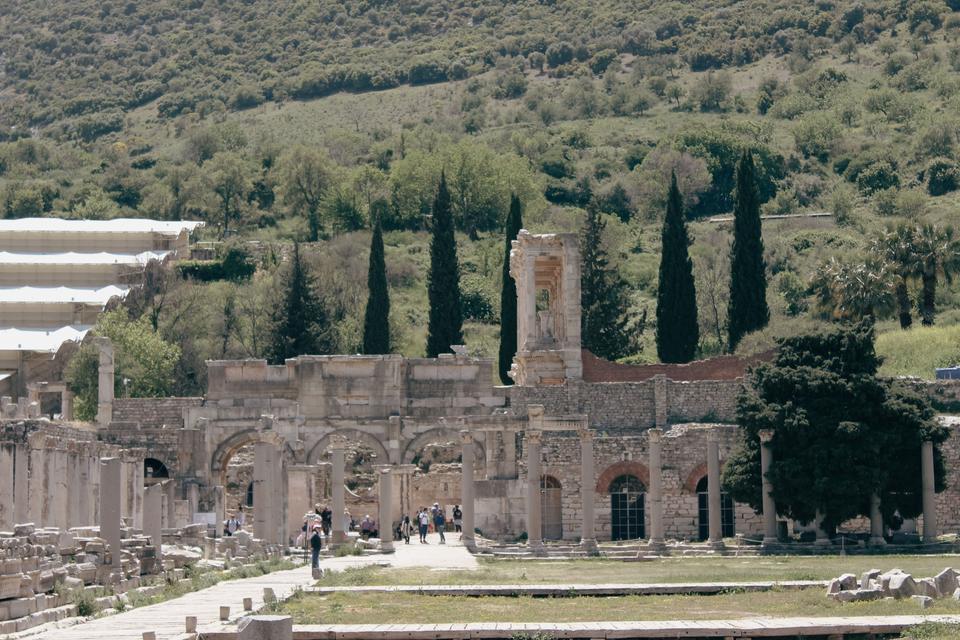
It is a long, open square, with the line of the basilica along its north side and the foundations of a small temple in its western half. It was laid out in the time of Augustus, and the buildings around it went on being rebuilt and added to for the next two centuries.
It sits in the saddle between the two hills that frame Ephesus, Panayır Dağı to the north and Bülbül Dağı to the south. When you enter at the Upper Gate, the ground opens out in front of you almost at once. That open ground is the square.
What is the Basilica Stoa along the north side?
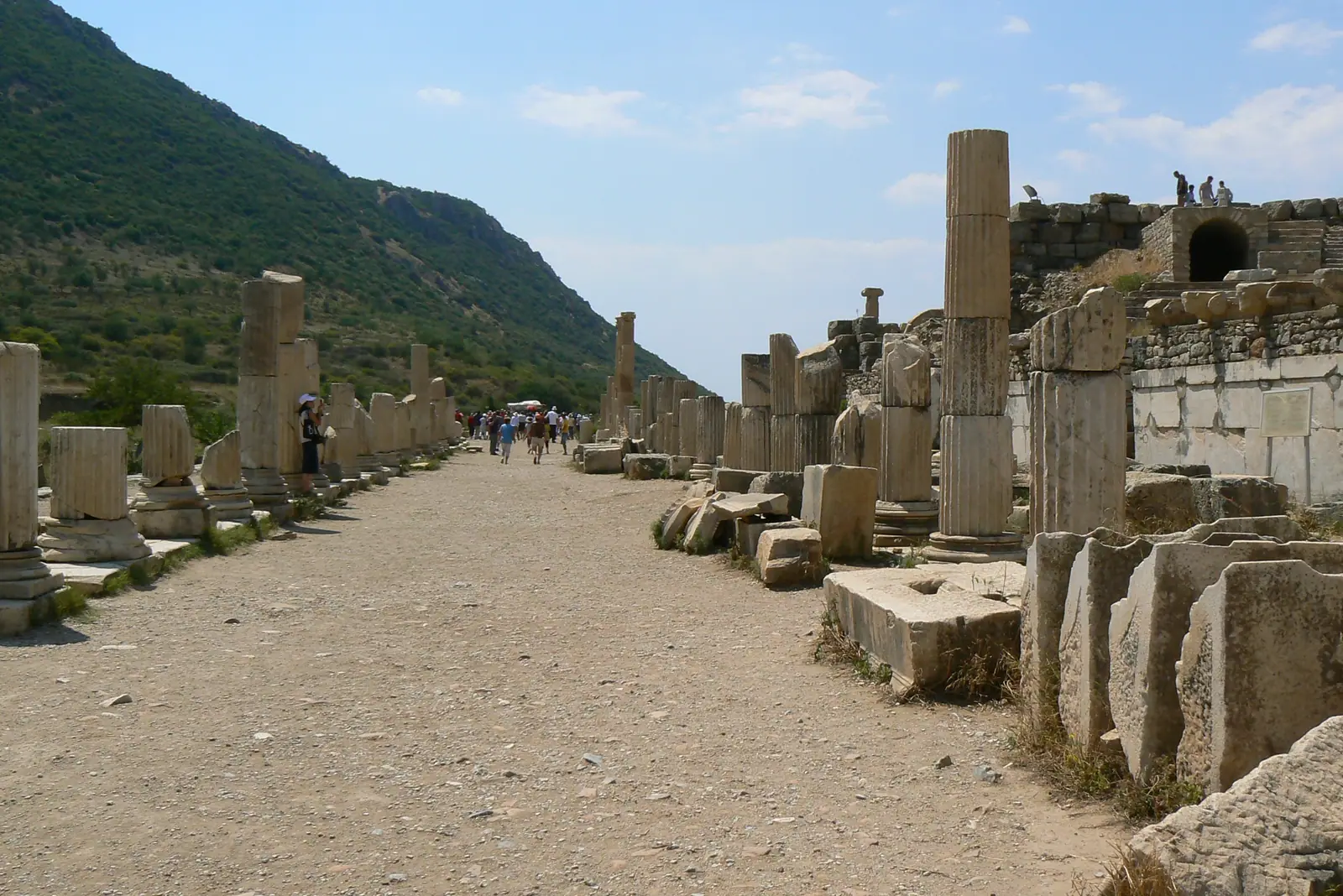
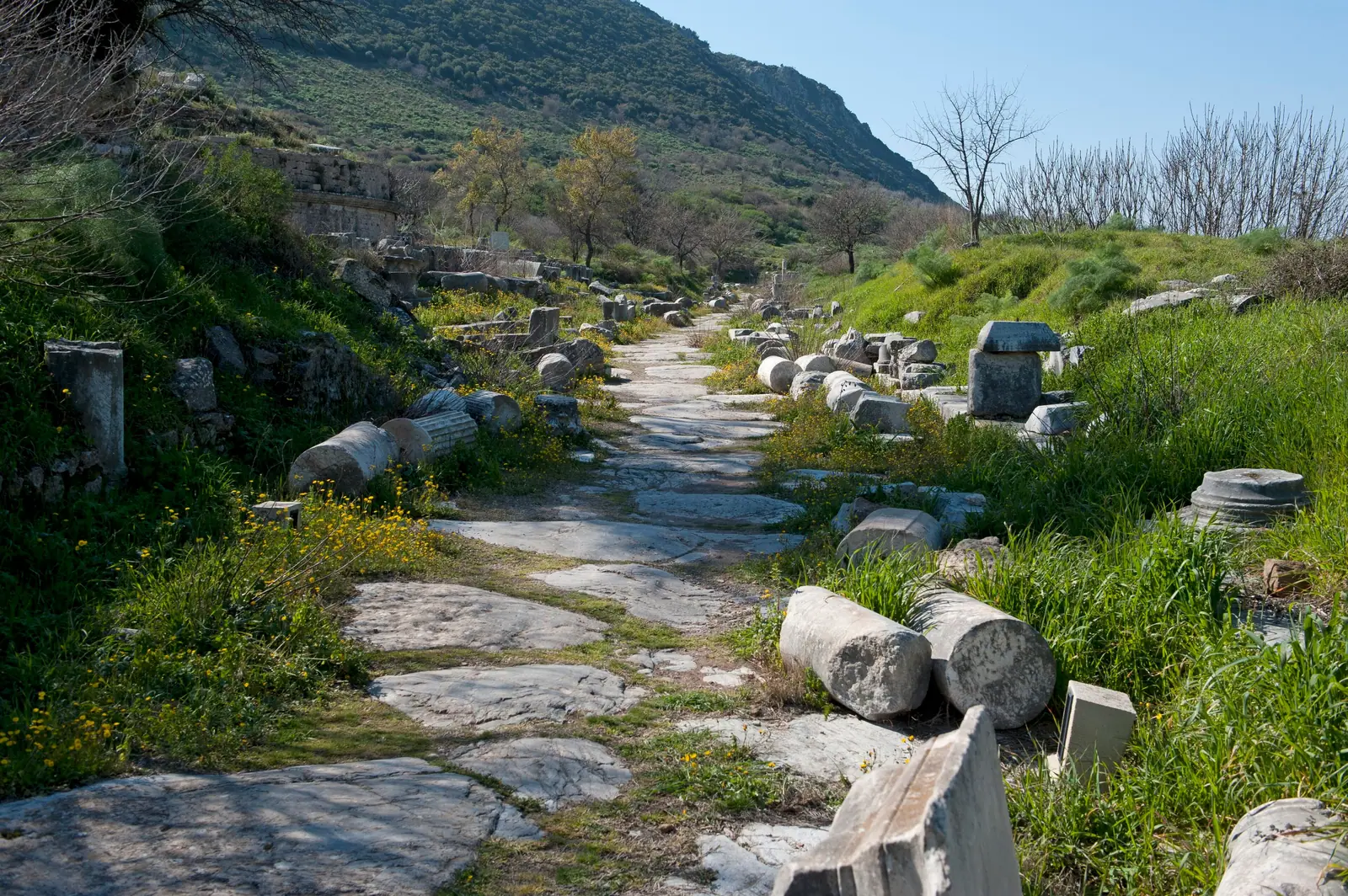
The Basilica Stoa was a long covered hall that ran the north edge of the square, where a line of column stumps runs today. It was built in AD 11, had two stories and three aisles, and its front showed 67 Ionic columns. Four steps led up from the square into the hall.
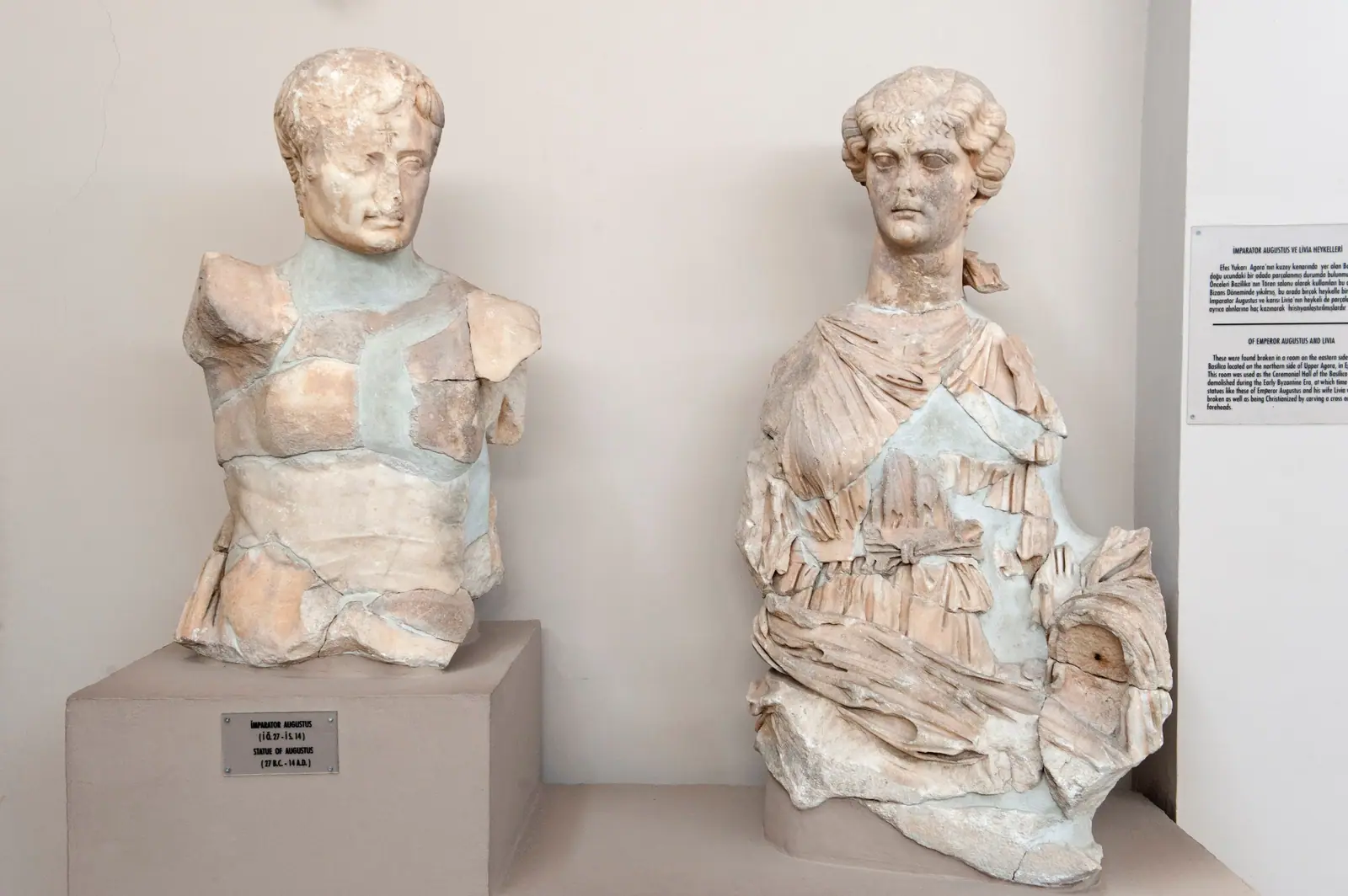
Roman basilicas like this one housed courts and business out of the sun. At its east end, nearest the gate, a room held large seated statues of Augustus and his wife Livia. Both statues are in the Ephesus Museum in Selçuk now, and if you look at Augustus's forehead you will see a cross cut into the marble: Christians of a later century made sure nobody mistook him for a god.
It is sometimes called the Royal Colonnade, a translation of its Greek name, basilike stoa.
Planning the day? Match a tour to your hours ashore
-
Time in port: Under 5 hours ashore
The Open-Air Circle
No tickets and almost no walking: Artemis, Selcuk and a drive past the ruins.
Tour length: 3-4 hours
-
Time in port: 5 to 8 hours
Just Ephesus
Ephesus from the Upper Gate down to the Lower Gate, and back with time to spare.
Tour length: 3-3.5 hours
-
Time in port: 8 to 9 hours
Marble, Mosaics and Artemis
All of Ephesus, the Terrace Houses and the Temple of Artemis.
Tour length: 5.5-6.5 hours
-
Time in port: 9 hours or more
The Road of Paul and John
Ephesus, the House of the Virgin Mary, St. John and Artemis.
Tour length: 6-7 hours
-
Time in port: Late arrival, tender or tight call
All-Aboard Ephesus
We plan backward from all-aboard and fit in only what fits.
Tour length: Fits your call
-
Time in port: You have your own list
Your Ship, Your Day
Tell us your ship and your wishes; we build the day around both.
Tour length: Fits your call
Every tour is private and priced from €33 per person for groups of 8 or more; smaller groups get a private quote. Any group size: 1 to 52 people per coach, and more coaches for larger groups. Entrance tickets are extra, at the official price.
What happened in the Odeon?
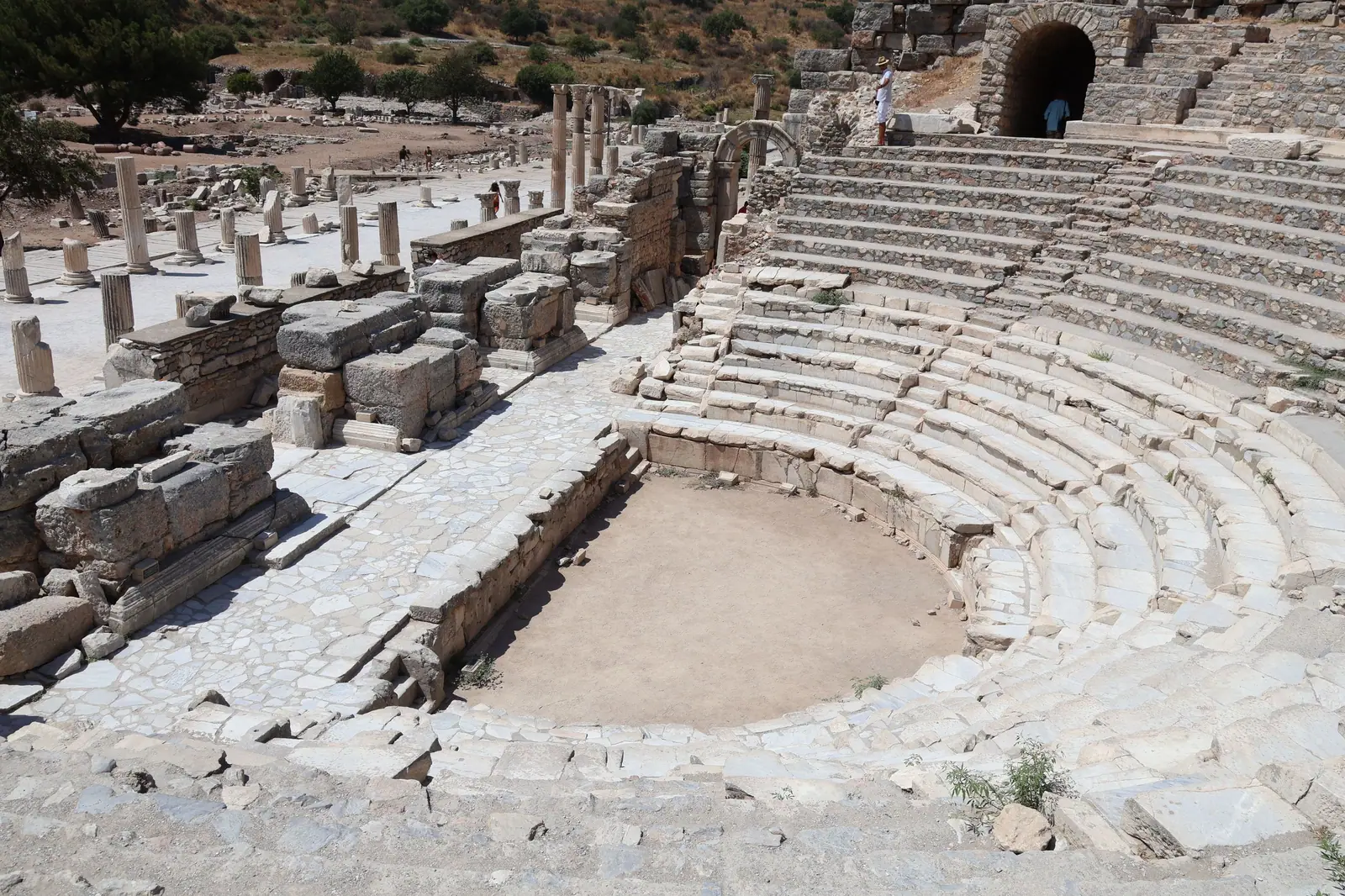
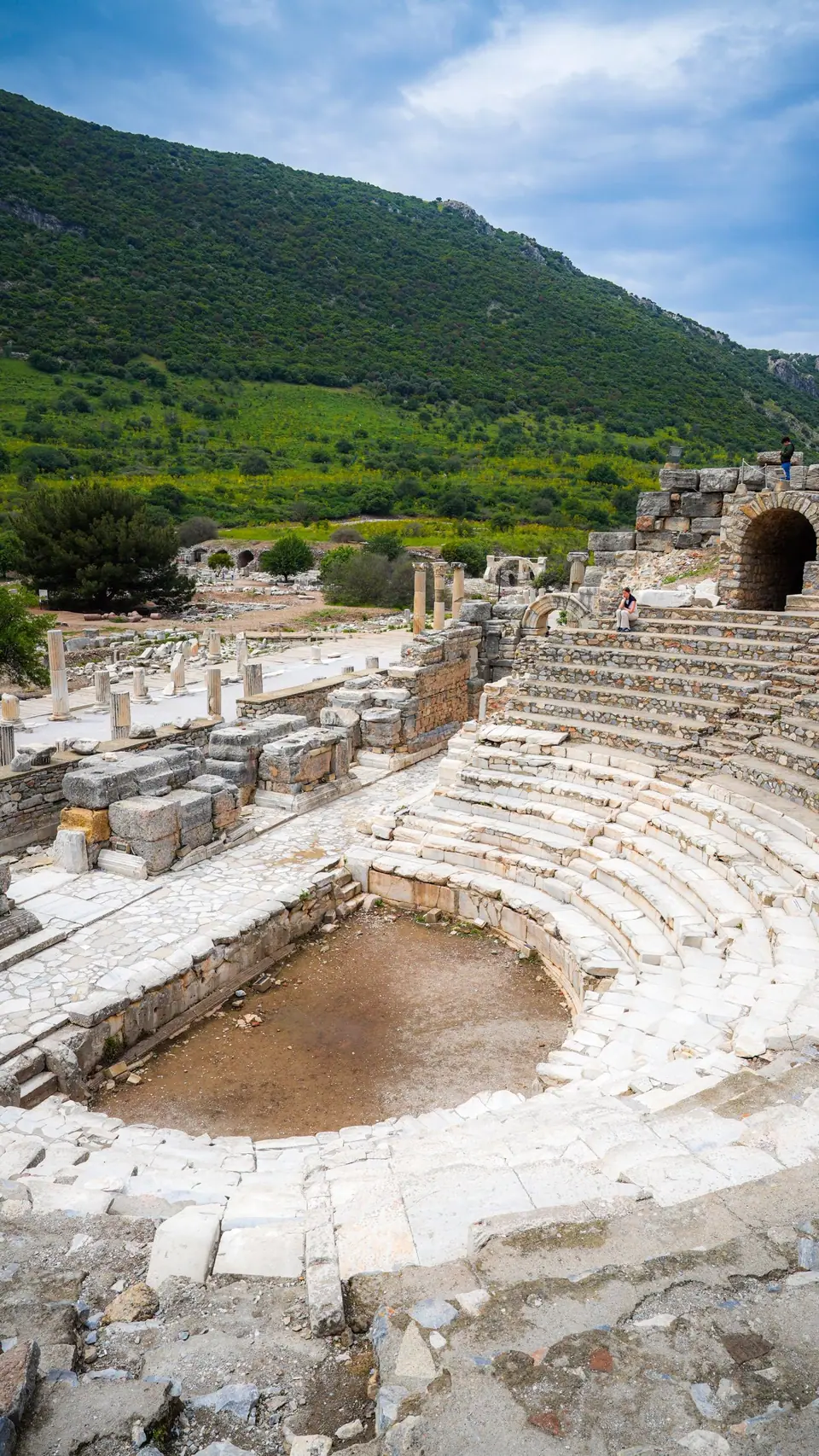
The city council met here. The Odeon is the small marble theater behind the basilica, with about 1,400 to 1,500 seats and a semicircular orchestra. Ephesus was governed by two bodies: the people's assembly, which met in the Great Theater, and the boule, the city council, which sat in this much smaller room. For that reason you will also see it called the Bouleuterion.
Between sessions it served for concerts and lectures; an odeon was a hall for music. A wealthy citizen, Publius Vedius Antoninus, paid for it with his wife around AD 150, and it had a roof, so meetings and music went on in shade and out of the rain. Its upper part was decorated with columns of red granite, and the entrances were on both sides of the stage.
It is the first place on the walk where a group naturally stops. The seats face the square, the hills close the view behind, and it is easy to picture the councillors filing in.
What was the Prytaneion?
The Prytaneion was the city hall, and the home of the sacred flame of Ephesus. Dedicated to Hestia, goddess of the hearth, it kept a fire that was never allowed to go out, and the Prytanis, the chief magistrate, was responsible for it. Official guests were received here.
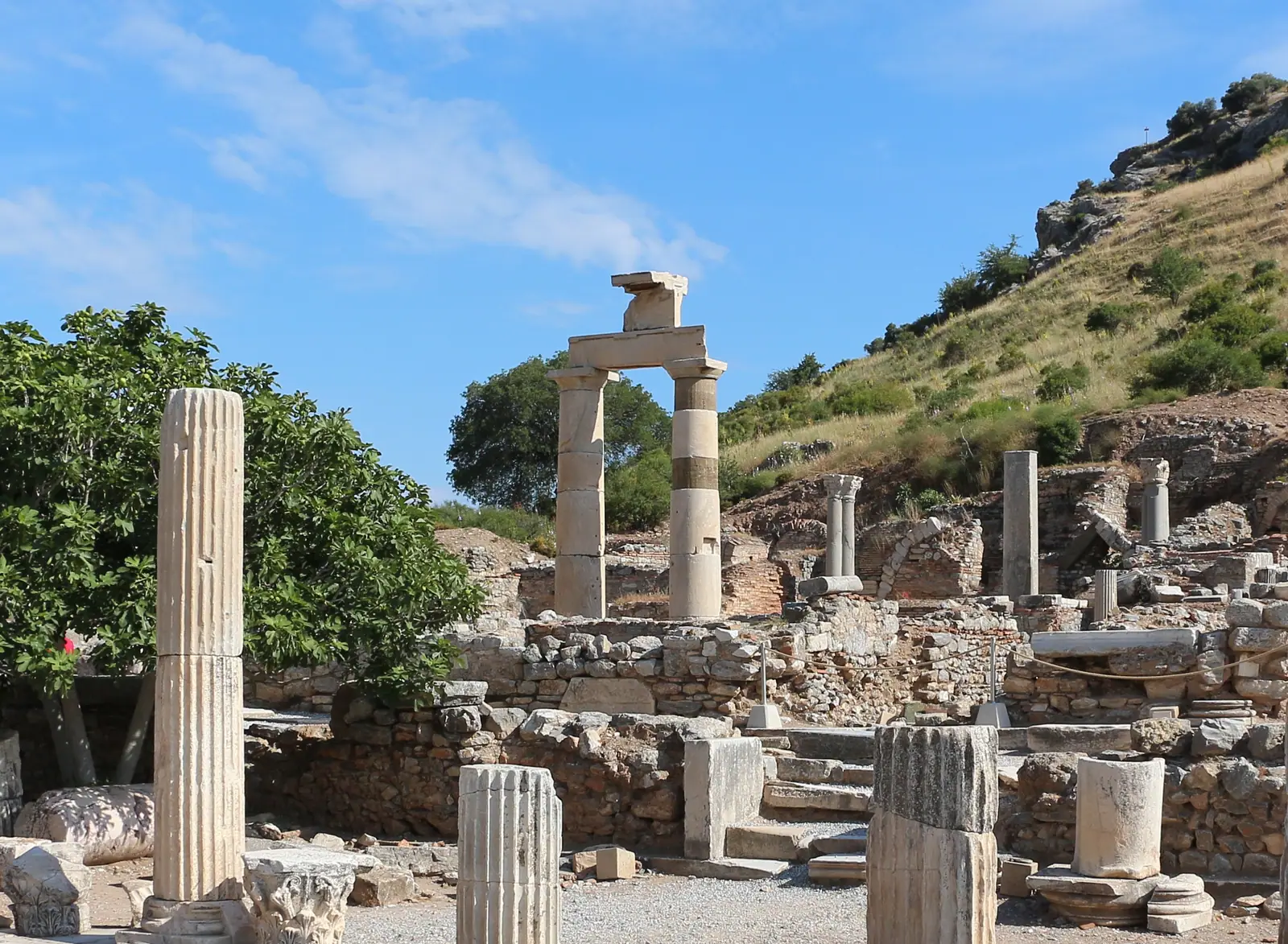
The names cut into its columns belong to the Curetes, a college of priests and officials tied to the Temple of Artemis who also met in this building. Two of the columns have been set back up at the entrance, and the foundations behind them, with the outline of a colonnaded courtyard, are the part you walk past.
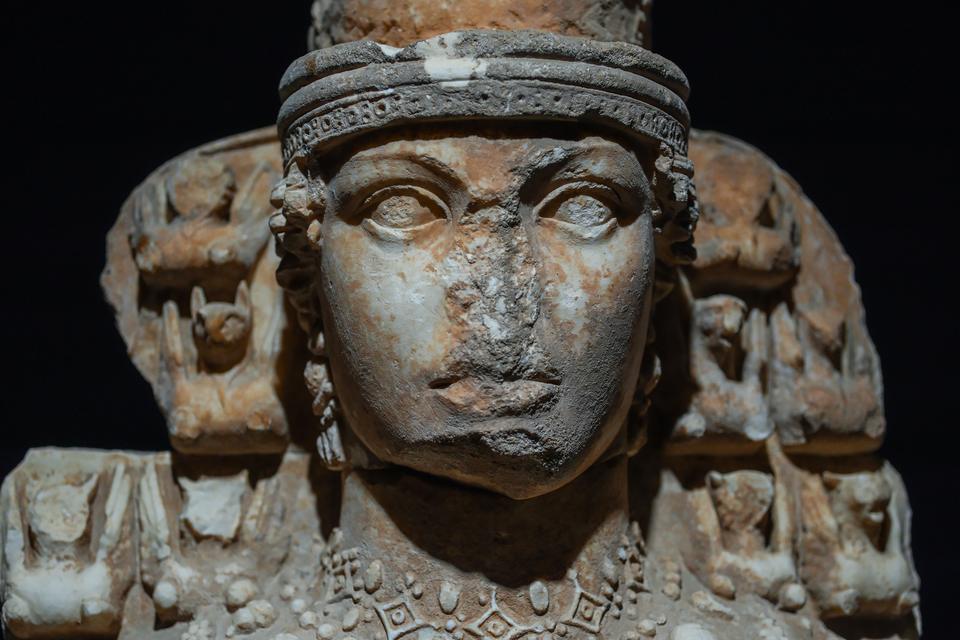
The Prytaneion also gave the museum its most famous pieces. The marble statues of Artemis of Ephesus, the ones with the rows of egg-shaped forms across the chest, were found here during the excavations, and they now stand in their own hall in the Selçuk museum.
What else stood on the square?
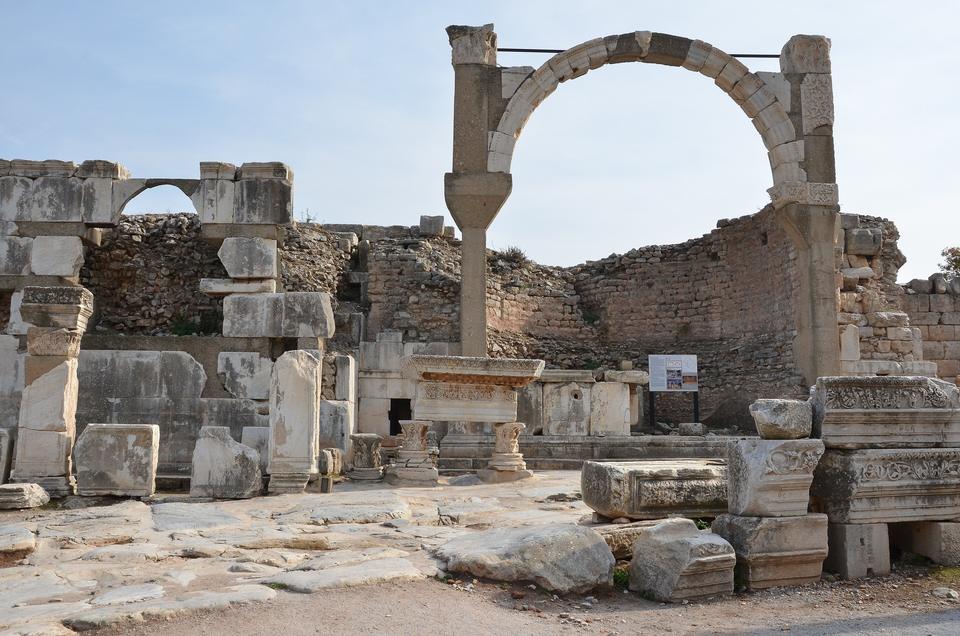
Two small temples, a monumental fountain at the southwest corner, and the Temple of Domitian's terrace at the far end. Here is what the main pieces were and what is left of each.
| Monument | What it was | What you see today |
|---|---|---|
| Basilica Stoa | Covered hall for courts and business, AD 11 | A long line of column stumps along the north edge |
| Odeon | Council hall and concert hall, about AD 150 | Marble seats, orchestra and restored podium |
| Prytaneion | City hall with the sacred flame | Two re-erected columns, the hall and courtyard foundations |
| Double temple | Small imperial-cult shrine between the Odeon and the Prytaneion | Low foundations, hard to read without a guide |
| Temple in the square | Small temple of about AD 15, 22 columns, about 23 by 15 meters | An outline of foundations in the western half |
| Temple of Domitian | Provincial imperial-cult temple, AD 89/90 | The terrace wall and vaults closing the west end |
The temple in the square is the one archaeologists argue about. Some read it as a temple of Isis, others as a shrine of the deified Julius Caesar and the goddess Roma. Our page on the Temple of Domitian covers the big terrace at the west end and the square beyond it.
Where is the State Agora on a walk through Ephesus, and how long do you spend there?
Right at the start, if you enter at the Upper Gate, as most guided tours do, ours included. The Upper Gate is the ancient Magnesian Gate, the east gate of the walls on the road to the House of the Virgin Mary; our page on the Upper and Lower Gates explains why nearly everyone starts at the top. From the gate the order is simple:
- the remains of the East Gymnasium, beside the gate
- the State Agora, with the basilica's column line on your right
- the Odeon, behind the basilica
- the Prytaneion, a few steps further on
- Domitian Square, with the Memmius Monument and the Pollio Fountain
- the Hercules Gate, and then Curetes Street running downhill to the Library of Celsus
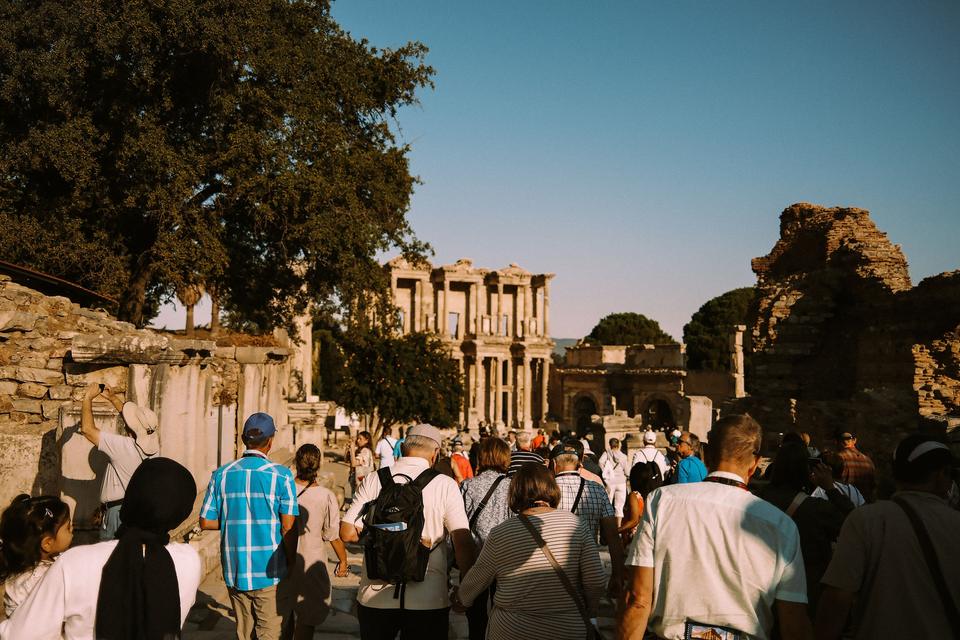
A guided group spends about 15 to 20 minutes here, enough for the Odeon and the Prytaneion and the story of the square; the longer stops come later, on Curetes Street. There is almost no shade on this upper stretch, so have hats and water ready before you leave the gate. Our How Long in Ephesus guide shows how the whole walk fits a port call.
One honest note for wheelchair users: the accessible route enters and leaves by the Lower Gate and stays in the lower city, so it does not climb to this square. Our wheelchair access page describes what that route includes.
Why does the square matter to readers of the Bible?
Because the men who ran Ephesus in Paul's day sat here. Acts 19 tells of the riot that filled the Great Theater, and it adds a detail that is easy to miss: some officials of the province, friends of Paul, sent him word not to go in. The council chamber and the city hall of that Ephesus are the Odeon and the Prytaneion on this square, and the Basilica Stoa was about 40 years old when Paul arrived.
The square also shows what the first Christians were up against. Augustus was honored with his wife in the basilica, a shrine of the imperial cult stood between the Odeon and the Prytaneion, and within a generation the far end of the square would carry a temple to the emperors for the whole province. Our Road of Paul and John tour walks this ground with those chapters in mind; our Just Ephesus tour covers it as part of the plain walk through the city. Tell us your ship and date through our inquiry form and we will plan the day around your hours.
Questions cruise guests ask us
Is the State Agora included in the Ephesus ticket?
Yes. It lies inside Ephesus Ancient City, so the standard Ephesus ticket covers it, along with the Odeon and the Prytaneion. Entrance tickets are not part of our tour price: we buy skip-the-line tickets in advance and you pay the official price. Our fees page lists the current amounts.
What is the difference between the State Agora and the Commercial Agora?
The State Agora in the upper city was for government: courts, the council, official ceremonies. The Commercial Agora, the large square beside the Library of Celsus in the lower city, was the marketplace, lined with shops. A walk from the Upper Gate to the Lower Gate passes through both, in that order.
Is the Odeon the theater where the riot in Acts 19 happened?
No. The riot filled the Great Theater, the huge open-air theater lower down the city that held about 24,000 to 25,000 people. The Odeon on the State Agora is a small roofed hall of about 1,400 to 1,500 seats where the city council met and concerts were held.
Where are the statues found on the State Agora now?
In the Ephesus Museum in Selçuk, a short drive from the ruins. The seated Augustus and Livia from the basilica and the Artemis statues from the Prytaneion both stand there. The museum is a separate ticket and takes about 40 minutes for the highlights.
Does the wheelchair route reach the State Agora?
No. The accessible route enters and leaves Ephesus by the Lower Gate and stays in the lower city, where the ground is flat. The State Agora is at the top of the site, reached from the Upper Gate, and the walk down from it to the Lower Gate is long and uneven.
Add Info Ephesus as a preferred source on GoogleGoogle then highlights our articles for you in Top Stories and in its AI answers.
Read next
Tell us your ship. We will plan the day around it.
Send your ship name, date and all-aboard time, and we reply with a plan and an exact price within 24 hours.
Get My QuoteNo prepayment · Reply within 24 hours · TÜRSAB 15746
Prefer email? info@infoephesus.com
